Roof Lantern or Flat Rooflight: Which Should You Choose?

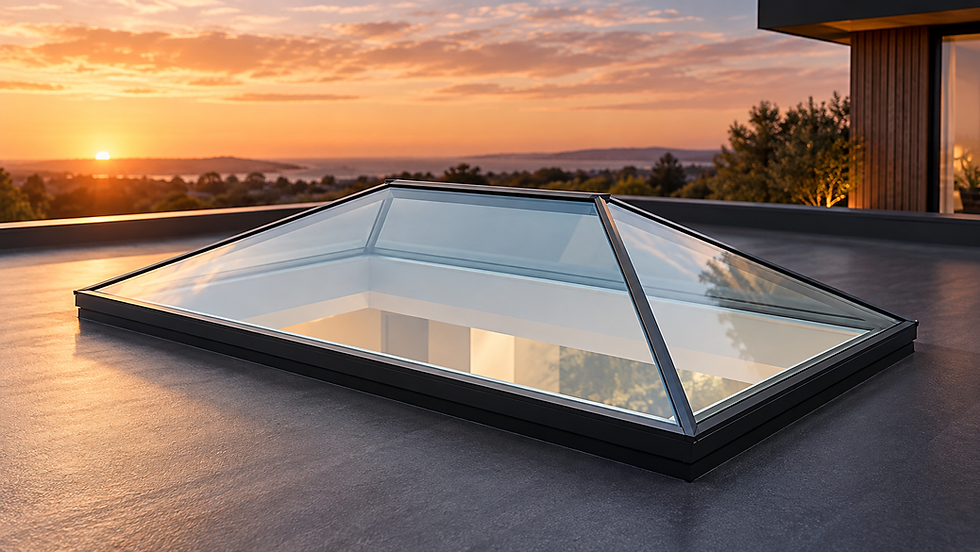
A roof lantern suits a project where you want a raised architectural feature and an expansive view of the sky. A flat rooflight suits a project where you prefer a discreet external profile and a simple glazed opening above the room. Both can bring daylight into an extension; the right choice depends on the roof design, glazing specification, ventilation needs and budget.
What is the difference?
A roof lantern has pitched glass panels supported by a frame that rises above the roof. From inside, this creates a feature above the ceiling opening. A flat rooflight has glazing in a much lower-profile unit. The term flat describes the style: the required installation fall and upstand details still need to follow the instructions for the particular product.
When does a roof lantern make sense?
A lantern can work particularly well above a kitchen island, dining area or central living space where the roof opening is part of the room’s design. Consider how the frame and pane layout will look from the positions where you spend most of your time. A larger lantern does not automatically mean a better result: its proportions should suit the room, furniture layout and available roof area.
Contemporary and traditional layouts create different views. Compare the actual pane arrangement for your chosen size, rather than assuming that every product photograph represents every available dimension. Frame colour also affects the appearance from inside, especially where the internal and external finishes differ.
When does a flat rooflight make sense?
A flat rooflight is a useful option when you want a clean ceiling opening and a discreet appearance from outside. It can suit smaller extensions, individual spaces or projects using several separate roof openings. Lumina Design supplies fixed and electric opening flat rooflights, so ventilation can be considered alongside the visual design.
A fixed rooflight brings in daylight but does not provide an opening for ventilation. An electric opening model can provide ventilation where reaching the rooflight manually would be impractical. Check the controls, electrical requirements and any optional sensors for the model before ordering.
Will either option make the room too hot?
Summer comfort depends on more than whether the unit is a lantern or a flat rooflight. The amount of glazing, orientation, shading, ventilation and glass specification all matter. Solar-control glass can reduce incoming solar energy, but it should be selected using the actual specification for the proposed glazing.
A low U-value describes resistance to heat loss; it does not tell you how much solar energy enters the room. For a meaningful comparison, ask about both thermal performance and solar performance. Also check whether a quoted U-value applies to the glass alone or to the complete product. These figures should not be treated as interchangeable.
Which costs less?
Compare complete quotations for the size and specification your project requires. Size, pane layout, frame finish, glazing and opening mechanisms can all affect the cost. Check whether VAT and delivery are included, and allow separately for the builder’s roof preparation, installation and any electrical work. A standard stock size may be worth considering if the roof opening has not yet been built.
Check measurements before building the opening
The structural opening and the external kerb dimensions are different measurements. Do not order from the ceiling opening alone. Lumina’s fixed and electric opening flat rooflights are ordered using external kerb dimensions. For any lantern or rooflight, confirm the product-specific drawing and installation requirements with us and your installer before finalising the kerb.
A practical way to choose
Start with the look you want from inside, then check the available roof space, glazing needs and whether ventilation is required. Ask your builder to confirm structural suitability and installation details. Finally, compare like-for-like quotations and the current availability for your selected specification.
For example, a dining space designed around a raised glazed feature may suit a lantern. A smaller room where a discreet roof profile and ventilation are priorities may suit an electric opening flat rooflight. These are starting points, rather than rules: the details of your project should determine the final choice.
Need help comparing the options?
Lumina Design is a supply-only specialist serving trade and DIY customers. Send us your proposed dimensions, preferred frame colours and whether you need an opening unit. We can help you compare suitable options and clarify the ordering measurements before you buy. Call 01656 630037 or email sales@luminadesign.co.uk.
Comments